Meet the Saxophone: History and the Family
Learn what a saxophone is, its history, the different types, and how it produces sound.
Your very first lesson from zero — start by getting to know your instrument
September 1, 2026 · Unit 1: "Getting to Know the Instrument"
Welcome to SaxStart. This is a serialized course that starts from absolute zero and climbs one step at a time along a complete path, all the way to the doorstep of jazz improvisation. The first lesson covers no technique and no breathing — it answers just three questions: Where did this instrument come from? Is it a woodwind or a brass instrument? And who are the members of its family?
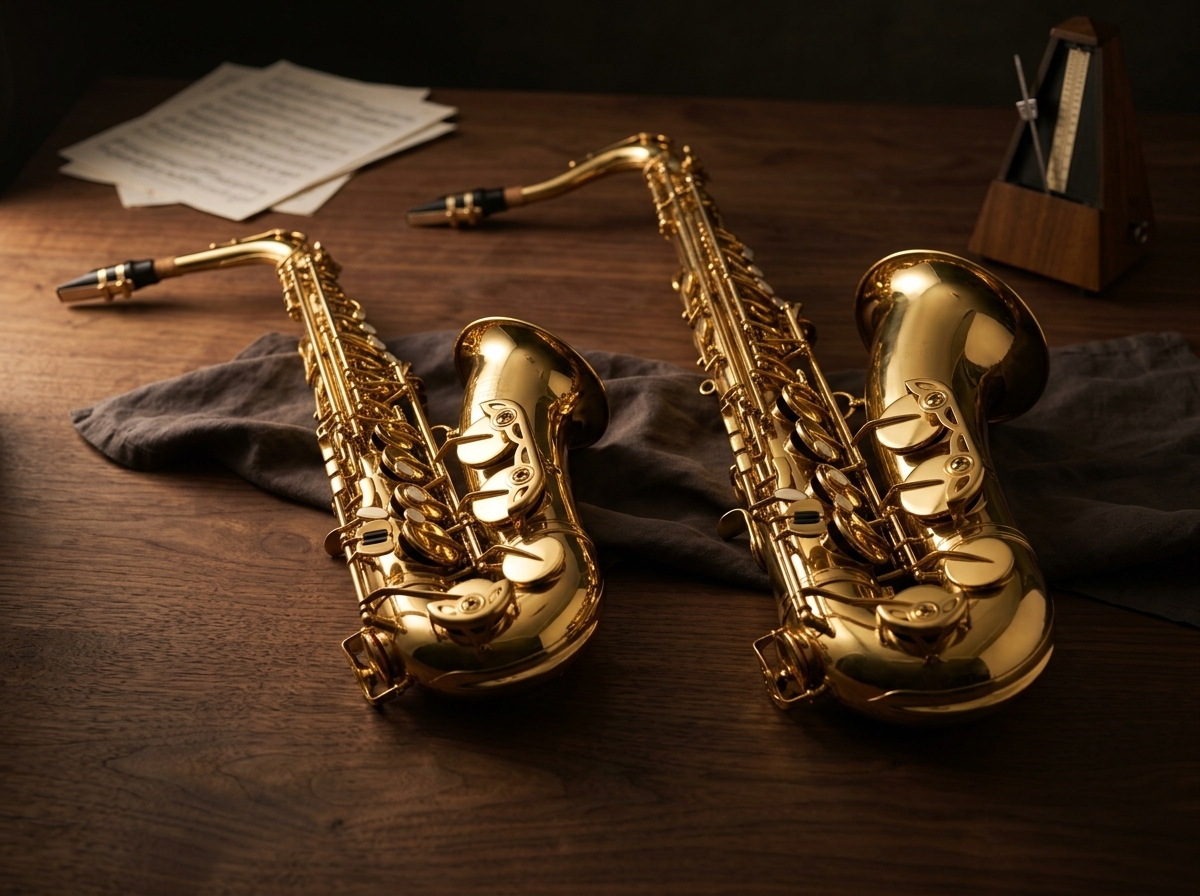
1. The Legacy of a Belgian Instrument Maker
The saxophone is a fairly young member of the wind-instrument family. It was designed in the 1840s by the Belgian instrument maker Adolphe Sax (1814–1894), who patented it in 1846 — and the instrument was named directly after its inventor's surname, something quite rare in the history of instruments. When designing this new instrument, Sax drew on the Boehm key system, which was already highly developed in Europe at the time (the same mechanical design used on the modern flute), and transplanted it onto his invention. As a result, the saxophone was born with a scientific and flexible key system. Belgians remain so proud of this history of invention that the saxophone has even appeared on the country's banknotes.
Remember three facts and names: the inventor, Adolphe Sax; the patent in 1846; the mechanical design derived from the Boehm key system. Later, when you study fingering, you will find that the arrangement of the keys is sensible at every turn — that is no coincidence; it is the instrument's "factory setting."
2. Woodwind or Brass? — A "Hybrid" That Belongs to Both
Beginners often wonder: the saxophone is clearly made of metal, so why does it always sit on the same side of the band as the clarinets and flutes? To answer that, you first need to know what instrument classification actually looks at. Wind instruments are categorized mainly by how they produce sound and the construction of the tube, not by the material on the surface.
The saxophone produces its sound through the vibration of a single reed — the same principle as the clarinet, which makes it a natural member of the "single-reed" family; and the way its tone holes open and close, along with its range, resembles the oboe. On the other hand, its body is made entirely of metal, and the range of its volume and dynamics is enormous — in terms of carrying power it can fully hold its own against the brass section. So we get an interesting picture: played loudly, it shines as brilliantly as a French horn; played softly, it retreats into the mellow warmth characteristic of woodwinds, with just a touch of metallic sheen.
This "dual identity" is not an identity crisis — it is precisely the root of the saxophone's tonal charm. It can sing lines of near-vocal tenderness and can also erupt with brass-like power. We will return to this point again and again in the lessons on tone.
3. The Four Main Family Members: One Fingering System for All
The four most widely used saxophones today happen to line up from high to low — soprano, alto, tenor, baritone — with keys alternating between B-flat and E-flat. Here is a summary table:
| Member | Key | One-line impression | | --- | --- | --- | | Soprano | B-flat | Mostly straight-bodied, slim and upright, with a bright, transparent tone (one of Kenny G's trademarks) | | Alto | E-flat | The most used and most popular; the first choice for beginners and classical players | | Tenor | B-flat | The main voice of jazz; a larger body that demands more breath | | Baritone | E-flat | Covers the low register; a thick, heavily curved and coiled body |
Here is a fact that is extremely friendly to learners: the fingerings of all four instruments are exactly the same. The fingering you work so hard to build on the alto can be transferred, unchanged, to the tenor or the soprano — what changes is only the size of the instrument, not the technical system. Also, remember the term "transposing instrument" for now: a note you press on the instrument does not sound at the same pitch as written on the staff (for example, written C on the alto sounds as E-flat). We will save the principle behind this for the lesson on scales and keys — for now, just having the impression is enough.
4. A Darling of the Composers
For a new instrument to gain a foothold, it needs composers to write for it. The saxophone was lucky: the nineteenth-century French composer Berlioz was among its earliest admirers, describing its sound as wonderfully layered, like echoing upon echoing — deep and calm, almost confiding, tender with a hint of melancholy — a tone no other instrument could replace. Later, Bizet, Saint-Saëns, Verdi, and other masters all found places for the saxophone in their scores. You could say that from the day it was born, this instrument was embraced by both the classical and the popular worlds.
5. Why Does Jazz Think "Saxophone" First?
The most essential feature of jazz is improvisation: strong and weak beats are constantly inverted, and continuous syncopation makes the rhythm endlessly variable; emotionally it swings between extremes — it can be fierce and frenzied or quiet and deep, comical and sorrowful at once. And the saxophone happens to cover all of these needs — its four techniques of glissando, vibrato, tonguing, and overblowing are exactly the most convenient tools for expressing jazz's dramatic tone colors and free rhythms.
Please take note of these four words: glissando, vibrato, tonguing, overblowing. They form the "class schedule" for the second half of this course — jazz needs exactly what the saxophone happens to be good at, and our job is to master these techniques one by one.
Key Points of This Lesson
- The Belgian instrument maker Adolphe Sax (1814–1894) completed the design around 1840 and obtained the patent in 1846; the key system derives from the Boehm design;
- Single-reed sound production + a brass body: the mouth of a woodwind, the body of a brass instrument — "loud like brass, soft like woodwind";
- The four common members: B-flat soprano, E-flat alto (the first choice for beginners), B-flat tenor, E-flat baritone;
- The whole family shares exactly the same fingerings; all are transposing instruments notated in treble clef;
- From Berlioz to jazz: glissando, vibrato, tonguing, and overblowing are the four magic tools that made it jazz's soul instrument.
Questions to Check Your Reading
- Why is the saxophone "both a woodwind and a brass instrument"? Give its woodwind evidence and its brass evidence, respectively.
- What are the keys of the four common saxophones? Which one is the first choice for beginners?
- What does "the whole family shares exactly the same fingerings" mean for a learner?
Next Lesson · Lesson 2, "How the Instrument Works: Mouthpiece, Reed, and Body": Now that we know the instrument's history, next time we open up the instrument itself — how does the breath make the reed vibrate? What are the "tip opening" and "facing" on a mouthpiece? Why do we say "your body is part of the instrument"? Let's take this instrument apart and look inside.
Continue Learning
Ready for the Next Step?
Follow our beginner learning path to build your saxophone fundamentals step by step.